Blog
How to Design Your Own Brand Tote Bag for OEM in China
Writer:admin Time:2025-08-07 18:29 Browse:views
If you are planning to build a tote bag brand and work with OEM factories in China, especially in places like Guangzhou, the real challenge is not finding a factory.
👉 The real challenge is designing a product that factories can actually produce consistently—and that customers will actually buy.
Many first-time brand owners make the same mistake:
They think “designing a tote bag” means just choosing a shape and adding a logo.
In reality, OEM tote bag design is a structured process involving:
material selection
construction planning
branding integration
cost control
manufacturing feasibility
This guide breaks everything down in a practical, real-world way based on how Chinese OEM factories actually work in 2025.
1. Start With the Brand Position, Not the Bag Design
Before you touch materials or sketches, you must define your brand direction.
Because in OEM production, design is always a reflection of positioning.
Ask yourself:
Is this a fashion brand or functional brand?
Is it affordable mass market or mid-premium?
Is it eco-focused or luxury-inspired?
Is it for daily use, office, or travel?
Without this clarity, factories cannot guide you properly, and your product will end up inconsistent.
Simple truth:
👉 Good tote bag design starts with market positioning, not aesthetics.
2. Understand OEM Design Constraints in China
When designing for OEM factories in China, especially Guangzhou, there are real constraints:
Production methods are standardized
Certain shapes are cheaper to produce
Complex structures increase cost significantly
Material availability affects design feasibility
So your design is not just creative—it must be manufacturable.
Example:
A clean rectangular tote:
easy to produce
stable structure
low defect rate
A highly curved designer tote:
harder pattern making
higher QC risk
more expensive sampling
3. Choose the Right Material for Your Brand
Material is the foundation of tote bag design.
In OEM factories, most tote bags fall into these categories:
PU leather (fashion & structured look)
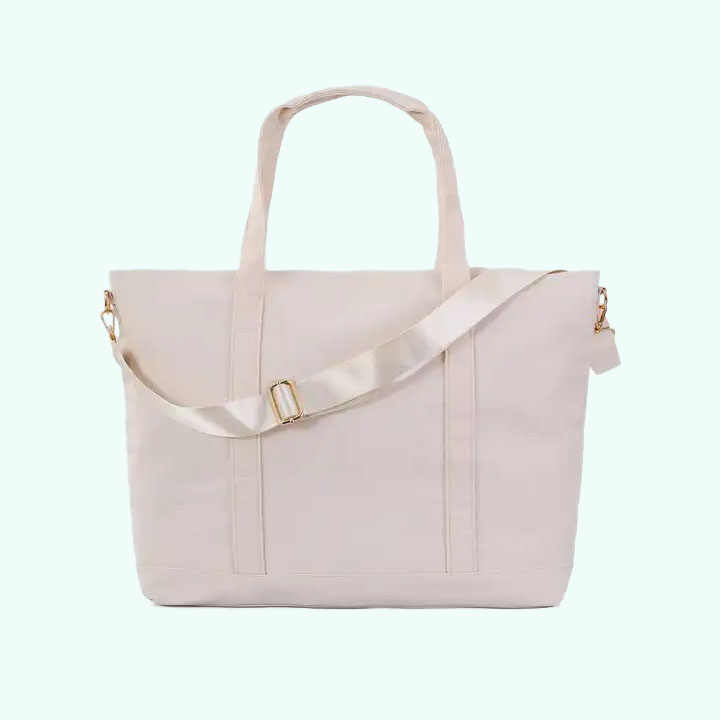
Canvas (eco & casual use)
Nylon (lightweight & travel use)
Genuine leather (premium segment)
Each material defines your brand identity.
📊 Table 1: Tote Bag Material Strategy for OEM Branding
| Material | Brand Image | Cost Level | Design Flexibility | Market Position |
|---|---|---|---|---|
| PU Leather | Fashion / Urban | Mid | High | Mass fashion brands |
| Canvas | Eco / Casual | Low | Medium | Lifestyle / eco brands |
| Nylon | Functional / Travel | Low-Mid | High | Utility brands |
| Genuine Leather | Luxury / Premium | High | Medium | High-end brands |
Key insight:
👉 Material is not just production choice—it is brand storytelling.
4. Define the Structure of the Tote Bag
Structure is what separates “cheap-looking” bags from “brand-level” products.
You must decide:
bag shape (square / trapezoid / soft / structured)
base reinforcement (yes or no)
internal compartments
zipper or open top
handle type and strength
Factories care about structure more than design sketches.
Common OEM mistake:
Designers focus on looks
Factories focus on structure stability
If structure is weak, the bag fails in mass production.
5. Design Branding Elements (Where Most Beginners Fail)
Branding is not just putting a logo on the bag.
In OEM tote bag design, branding can be applied in multiple ways:
embossed logo on PU leather
woven label inside lining
metal logo plate
printed pattern integration
zipper pull branding
packaging branding
Important rule:
👉 The more integrated the branding, the more “premium” the product feels.
But also:
👉 The more complex it becomes in production.
6. Functional Design vs Fashion Design
You need to decide your core direction:
Functional tote bags:
focus on storage
laptop compartments
waterproof materials
reinforced structure
Fashion tote bags:
focus on visual identity
shape aesthetics
seasonal trends
branding expression
Most successful brands actually combine both.
7. Translate Your Design into OEM Specifications
Factories do not work from ideas—they work from specifications.
You need to prepare:
size (L × W × H)
material specification
lining material
hardware requirements
stitching requirements
logo placement
packaging requirements
If you are unclear, factory output will be inconsistent.
8. Sample Development is the Most Important Stage
In China OEM production, sampling is where everything is decided.
Typical process:
first sample → structure test
second sample → refinement
final sample → mass production reference
📊 Table 2: OEM Tote Bag Development Stages
| Stage | Purpose | Buyer Focus | Risk Level |
|---|---|---|---|
| Concept | Define idea | Market positioning | High |
| Design | Convert to specs | Structure + material | High |
| Sampling | Prototype creation | Accuracy check | Very High |
| Revision | Optimization | Detail correction | Medium |
| Final Sample | Production reference | Lock standard | Very High |
9. Cost Awareness in Design (Very Important)
Many beginners design bags without thinking about cost impact.
But in OEM production, small design decisions affect cost heavily:
adding internal pockets increases labor
using thicker PU increases material cost
metal hardware increases assembly time
complex stitching increases defect risk
Rule:
👉 Every design feature must justify its market value.
10. How Chinese Factories Interpret Your Design
Factories do not “read design emotionally”.
They interpret it as:
production complexity
material availability
labor time
defect risk
So your job is to make design clear, not artistic.
Example:
Instead of saying:
“make it elegant and premium”
Say:
“structured PU tote bag with reinforced base, gold hardware, minimal stitching, inner zip pocket”
11. Packaging is Part of Design (Not Afterthought)
In OEM branding, packaging is part of product identity.
Options include:
dust bag
gift box
printed carton
eco packaging
📊 Table 3: Packaging Strategy for Tote Bag Brands
| Packaging Type | Brand Position | Cost Impact | Customer Perception |
|---|---|---|---|
| Poly bag | Low-cost | Very Low | Basic |
| Dust bag | Mid-range | Low | Professional |
| Gift box | Premium | High | Luxury feel |
| Eco packaging | Sustainable | Medium | Modern brand image |
12. Common Design Mistakes in OEM Tote Bags
Mistake 1: Over-designing
Too many features → high cost + unstable production
Mistake 2: Ignoring structure
Looks good but collapses in real use
Mistake 3: No clear target market
Design becomes “generic product”
Mistake 4: Not aligning with factory capability
Not all factories can execute complex designs
13. Realistic Design Strategy for 2025 Market
Successful tote bag brands today focus on:
minimal but functional design
strong material identity
consistent product line
scalable production design
TikTok / Amazon usability
📊 Table 4: Design Direction vs Market Fit
| Design Style | Demand Level | Scalability | Difficulty |
|---|---|---|---|
| Minimalist tote | Very High | High | Medium |
| Functional travel tote | High | High | Medium |
| Eco canvas tote | High | Medium | Low |
| Luxury leather tote | Stable | Medium | High |
| Trendy fashion tote | High | Medium | High |
Conclusion
Designing your own tote bag brand for OEM in China is not just a creative process—it is a system integration process.
A successful design must balance:
brand identity
manufacturing feasibility
cost structure
market demand
factory capability
The most important shift is this:
👉 You are not just designing a bag. You are designing a product that can be repeatedly manufactured at scale.
Once you understand this, OEM becomes much more predictable—and your brand becomes much easier to scale.
Related Article
CATEGORIES
LATEST NEWS
CONTACT US
Whatsapp: +86 18998453346
Phone: +86 18998453346
Tel: +86 18998453346
Email: [email protected]
Addr: Baiyun District, GuangZhou , Guangdong Province, China
Hot Goods
 <
<
 <
<
 <
<
 <
<
 <
<
<
<
<
<
 <
<
<
<
<
<