Quality Control
1. Introduction: Why Quality Control Defines a Handbag Brand
In the global fashion handbag industry, quality is not only a product requirement—it is the foundation of brand reputation, customer retention, and long-term business success. For OEM/ODM handbag manufacturing, especially in categories such as PU leather bags, nylon bags, vegan leather handbags, and genuine leather woven totes, a structured Quality Control (QC) system ensures that every product leaving the factory meets consistent standards.
At our manufacturing facility in Guangdong, China, we implement a multi-stage quality control system that covers every step of production—from raw material selection to final packaging inspection. This ensures that each handbag delivered to clients meets international expectations for durability, aesthetics, and functionality.
Our QC system is designed for:
Fashion brands
Private label companies
Wholesale distributors
E-commerce sellers (Amazon, Shopify, TikTok Shop)
Promotional product companies
The goal is simple: zero-defect delivery as far as possible, and continuous improvement at every stage.
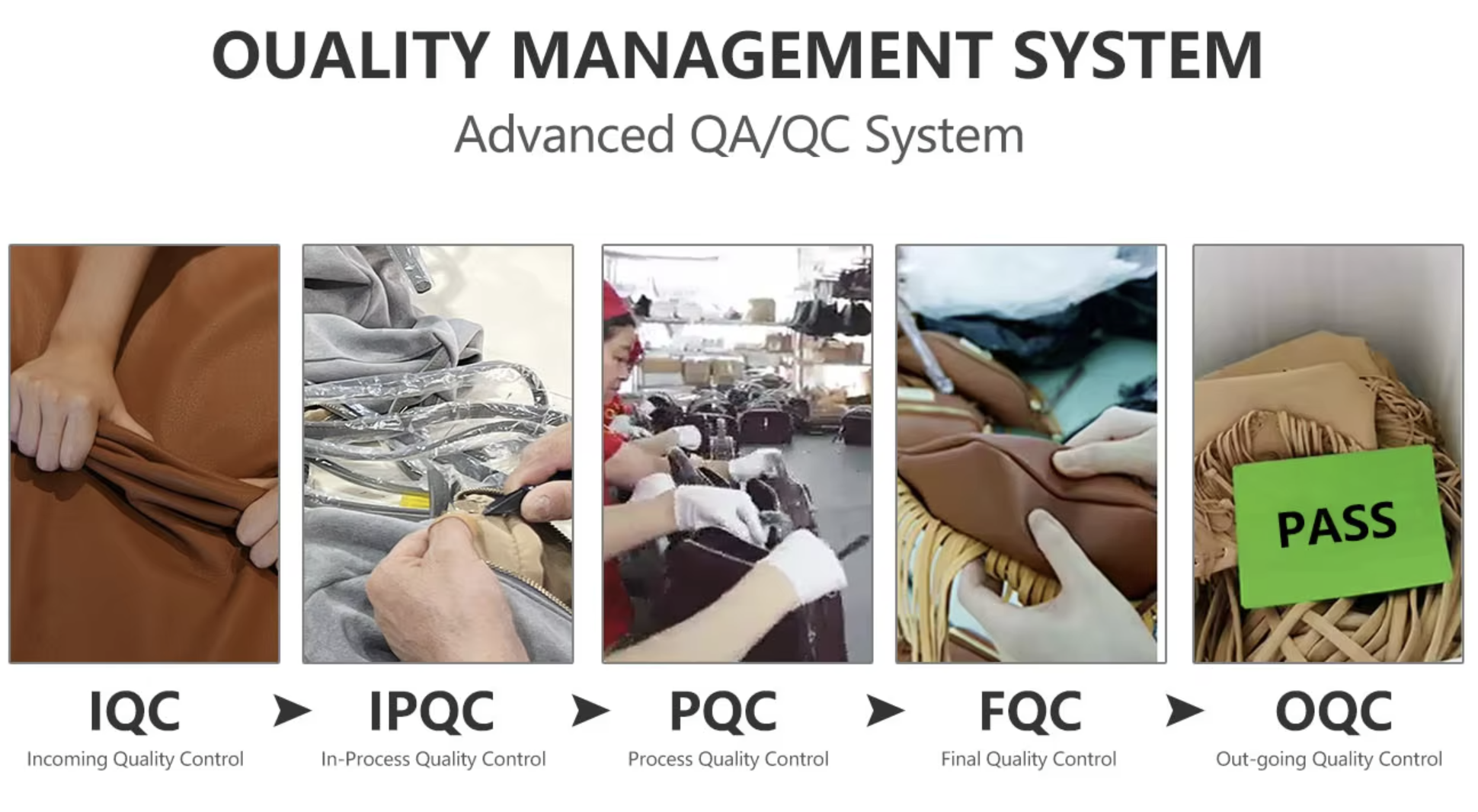
2. Raw Material Inspection (Incoming Quality Control – IQC)
Quality control begins long before production starts. The first and most critical stage is Incoming Quality Control (IQC), where all raw materials are inspected before entering the production line.
2.1 PU Leather Inspection
For PU leather handbags, we test:
Surface texture consistency
Color uniformity (no shading differences)
Thickness accuracy
Flexibility and bending resistance
Scratch resistance performance
Odor level (non-toxic compliance)
PU materials must meet both visual and physical standards to ensure consistency across bulk production.
2.2 Genuine Leather Inspection
For real leather bags:
Natural grain evaluation
Defect marking (scars, wrinkles, holes)
Softness grading
Tensile strength testing
Color absorption consistency
Water resistance treatment check
Only Grade A leather is approved for luxury OEM production.
2.3 Fabric & Nylon Material Inspection
For nylon and fabric handbags:
Yarn density test
Tear resistance test
Waterproof coating verification
Color fastness (rub test)
Weight consistency
This ensures durability for travel bags, beach bags, and puffer tote bags.
2.4 Hardware Inspection (Zippers, Buckles, Chains)
Hardware is a critical failure point in handbags. We inspect:
Zipper smoothness
Puller strength
Metal plating durability
Anti-rust performance
Color consistency (gold/silver/gunmetal)
Load-bearing test for buckles and hooks
Only hardware that passes cycle testing is approved for production.
3. Cutting & Pattern Accuracy Control
After materials are approved, the next stage is precision cutting and pattern alignment.
3.1 Pattern Matching
We ensure:
Symmetry between left and right panels
Alignment of checkered, woven, or printed patterns
No distortion on curved shapes (hobo, pillow, Boston bags)
3.2 Cutting Precision
Using advanced cutting machines and skilled technicians:
Error tolerance is kept within ±1–2 mm
Layer consistency is checked
Fabric stretching is controlled
Leather grain direction is optimized
Precision at this stage ensures the final handbag maintains structural integrity and professional appearance.
4. Stitching Quality Control (SQC)
Stitching is one of the most important aspects of handbag durability and aesthetics.
4.1 Stitch Density Control
We standardize:
Stitch per inch (SPI) depending on product type
Reinforced stitching at stress points
Double stitching for handles and straps
4.2 Thread Quality Inspection
We check:
Thread tensile strength
Color matching with material
Anti-fray performance
UV resistance for outdoor bags
4.3 Seam Strength Testing
Each production batch undergoes:
Pull force testing
Load-bearing simulation
Repeated stress bending tests
This ensures bags can withstand daily use under real-world conditions.
5. Assembly Quality Control (AQC)
During assembly, multiple components are combined into a finished product.
5.1 Structural Alignment
We inspect:
Bag symmetry
Shape consistency (tote, hobo, crossbody, Boston, pillow)
Handle positioning accuracy
Strap attachment angle
5.2 Internal Structure Check
Inside the bag, we verify:
Lining installation quality
Pocket placement accuracy
Seam concealment
No loose threads or exposed edges
5.3 Functional Testing
We test:
Zipper opening/closing cycles (minimum 100 cycles)
Button/lock durability
Strap adjustment mechanism
Load capacity simulation
6. Surface & Appearance Inspection (Final Visual QC)
At this stage, the handbag is fully assembled and undergoes strict visual inspection.
6.1 Surface Defect Check
We inspect for:
Scratches
Glue marks
Uneven coloring
Wrinkles or bubbles
Printing misalignment
Leather grain inconsistencies
6.2 Shape Consistency
We ensure:
No deformation
Proper bag structure retention
Correct proportions
Balanced weight distribution
6.3 Color Consistency
We perform:
Batch color matching
Light exposure comparison
Pantone accuracy verification
Consistency is critical for brand identity, especially for multi-color collections.
7. Functional Testing (Real Use Simulation)
To ensure real-world reliability, we simulate daily usage conditions.
7.1 Load Testing
Each bag is tested with:
Standard weight load (0.5–5kg depending on product type)
Long-duration stress testing
Carrying simulation
7.2 Wear Simulation
We simulate:
Shoulder strap friction resistance
Zipper repeated use cycles
Surface rubbing tests
7.3 Environmental Testing
We evaluate:
Water resistance exposure
Heat resistance
Humidity storage conditions
This ensures products perform well in global markets with different climates.
8. Packaging Quality Control (PQC)
Packaging is the final stage before shipment and is crucial for brand presentation.
8.1 Packaging Inspection
We check:
Correct folding method
Dust bag inclusion
Box integrity
Protective wrapping quality
8.2 Label Accuracy
We verify:
SKU accuracy
Barcode correctness
Brand logo placement
Product information consistency
8.3 Drop Test Simulation
To ensure shipping safety:
Box drop testing from standard height
Shock resistance evaluation
Corner protection testing
9. Final Quality Inspection (FQC)
Before shipment, every batch undergoes Final Quality Control (FQC).
FQC Includes:
100% visual inspection
Sampling re-check (AQL standard)
Function re-testing
Packaging confirmation
Final approval signature
Only products that pass FQC are approved for export.
10. Quality Grading System
We classify products into:
Grade A (Export Standard)
Perfect appearance
No functional defects
Fully approved for retail
Grade B (Minor Cosmetic Variation)
Slight aesthetic imperfections
Still functional
Used for discounted channels
Reject (Scrap or Rework)
Structural or functional defects
Not allowed for shipment
11. Continuous Improvement System (CIP)
Quality control is not static—it evolves continuously.
We implement:
Monthly defect analysis reports
Production feedback loops
Worker skill training programs
Supplier improvement audits
Customer feedback integration
This ensures long-term product improvement and reduced defect rates.
12. OEM Brand Quality Assurance Commitment
We support global OEM clients with:
Stable quality across bulk orders
Consistent color matching
Customization accuracy
Fast sampling and correction cycles
Transparent production communication
Our goal is to help brands build trustworthy, scalable, and premium product lines.
13. Conclusion: Quality as the Foundation of Brand Success
In the handbag industry, design attracts attention—but quality builds reputation.
Our comprehensive QC system ensures that every handbag, whether PU leather tote, nylon puffer bag, woven leather luxury bag, or mini crossbody purse, meets strict international standards.
From raw material selection to final packaging, every step is controlled, measured, and continuously improved.
This is how we guarantee:
Consistent product excellence
Reliable OEM manufacturing
Strong brand reputation support
Long-term business partnerships
Because in fashion manufacturing, quality is not a stage—it is the entire process.
CATEGORIES
LATEST NEWS
CONTACT US
Whatsapp: +86 18998453346
Phone: +86 18998453346
Tel: +86 18998453346
Email: [email protected]
Addr: Baiyun District, GuangZhou , Guangdong Province, China