Blog
Custom Tote Handbag Manufacturer in Guangzhou – 2025 Guide
Writer:admin Time:2025-08-07 18:29 Browse:views
If you are in the handbag business—especially in e-commerce, private label branding, or wholesale sourcing—you will eventually end up looking at Guangzhou.
To be honest, it’s not even really optional anymore.
If you want OEM handbags made in China, Guangzhou is where most of the real supply chain sits.
But here’s the part many people only learn after they start sourcing:
👉 Guangzhou is not just “a manufacturing city”
👉 It’s a dense ecosystem of very different types of factories
And that’s where most buyers either succeed—or get confused.
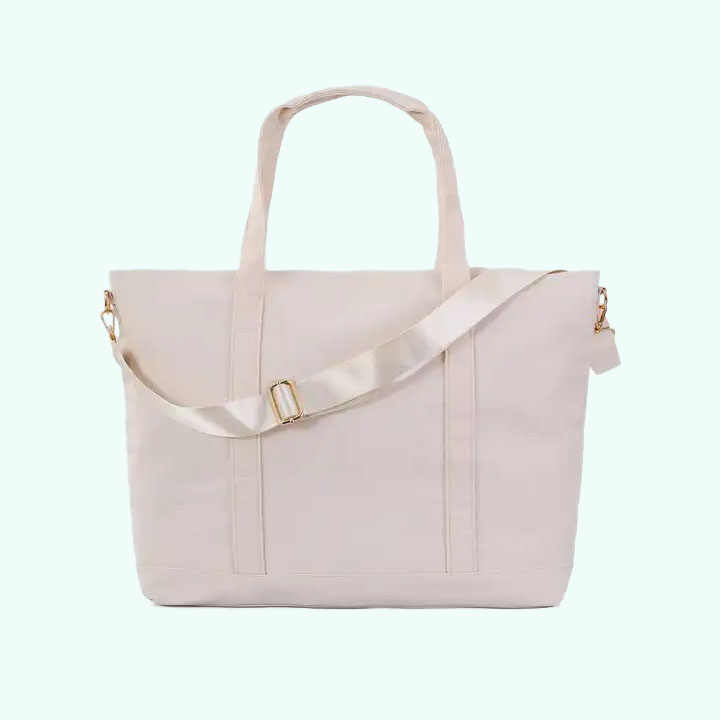
Why Guangzhou is still the center of handbag manufacturing
It’s not just about cost.
The real advantage of Guangzhou is speed and completeness.
Within a relatively small industrial area, you can find:
PU leather suppliers
Genuine leather tanneries
Nylon and fabric mills
Hardware factories (zippers, buckles, chains)
Sample workshops
Mass production factories
Packaging suppliers
So when a design is ready, everything can move quickly—from prototype to bulk production.
That’s why even in 2025, most fashion handbag sourcing still comes back here.
But here’s the reality most buyers don’t expect
When people first come to Guangzhou, they usually think:
“There are so many factories, I should easily find a good one.”
But the real experience is different.
Because you’re not choosing between “good and bad factories”.
You’re actually choosing between different types of factories with different business logic.
And this is where mistakes happen.
3 types of handbag factories in Guangzhou
1. Low-cost production factories
These are the most aggressive on pricing.
You will usually see:
Very fast quotation
Wide product range
Flexible MOQ
Quick sampling
But there are trade-offs:
Quality can vary between batches
Less attention to fine finishing
Not very strong in product development
Focused on volume, not branding
These factories are usually best for:
👉 Marketplace sellers testing products
👉 Low-price fast-moving SKUs
👉 Short lifecycle designs
2. Standard OEM factories (most common)
This is the biggest group in Guangzhou.
They are real factories, stable, and capable of production.
Typical characteristics:
Can produce your design
Can do logo customization
Have basic QC process
Understand export requirements
But there is a limitation:
They are execution-focused, not design-driven.
Meaning:
👉 They don’t usually improve your product
👉 They don’t challenge your design decisions
👉 They build exactly what you give them
So if your tech pack is weak, the final product will reflect that.
3. Brand-level manufacturers (smaller group)
These are harder to find, but very important if you want long-term brand building.
They usually offer:
Better material suggestions
More stable quality control
Stronger sampling accuracy
More structured production process
But:
Higher MOQ
Slightly higher pricing
Longer development time
In exchange, you get consistency.
And in fashion business, consistency matters more than people think.
The biggest mistake: choosing only by price
A lot of new buyers make the same mistake:
“This factory is cheaper, let’s go with them.”
But in handbag manufacturing, price differences are usually not about materials.
They are about:
Labor skill level
Production stability
Quality control system
Factory experience with exports
Two bags can look identical in photos, but behave completely differently after 2–3 months of use.
That’s the part you don’t see in quotations.
The second common issue: sample vs bulk mismatch
This is one of the most frustrating problems in OEM production.
The sample looks perfect.
Then bulk production arrives… and something feels different.
This usually happens because:
Sample is manually refined
Bulk uses different production flow
Materials get slightly changed in sourcing
QC standards were not clearly locked
So experienced buyers always insist on:
Pre-production sample approval
Material locking (especially PU or leather batch)
Production reference sample
Clear QC checklist before mass production
A simple way to judge a serious factory
During communication, ask this question:
“If I plan to develop this into a long-term product line, what would you improve?”
The answer tells you a lot.
If they say “no need to change anything” → usually basic factory
If they start discussing structure or materials → more professional OEM
If they talk about cost-performance optimization → likely strong manufacturer
Because real manufacturers think beyond just “making the bag”.
They think about how it performs in the market.
📊 Factory comparison table
| Type | Strength | Weakness | Best For |
|---|---|---|---|
| Low-cost factory | Cheap & fast | Inconsistent QC | Marketplace testing |
| Standard OEM | Stable & flexible | Limited design input | Small–mid brands |
| Brand-level factory | Consistent quality | Higher MOQ | Long-term brands |
What actually matters in 2025 OEM sourcing
At this point, most successful brands are no longer asking:
“Who is the cheapest supplier?”
They are asking:
Can this factory keep consistency for 6–12 months?
Can they reproduce the same quality across batches?
Can they understand my target market?
Can they scale when my orders grow?
Because once your product starts selling, the real challenge is not making one good sample.
It’s repeating that success 1,000 times.
📊 How to evaluate factory capability
| Area | Weak Factory | Strong OEM Factory |
|---|---|---|
| Sampling | Fast but unstable | Slightly slower but accurate |
| Communication | Passive | Asks detailed questions |
| Quotation | One-line price | Breaks down structure |
| QC system | Basic check | Multi-stage inspection |
Final thoughts
Guangzhou is still one of the strongest handbag manufacturing ecosystems in the world.
But success here is not about finding “a factory”.
It’s about finding the right type of factory for your stage of business.
If you are:
Testing products → low-cost factory may be enough
Building a brand → OEM stability matters more than price
Scaling → consistency becomes everything
Because in the end, handbag manufacturing is not just about production.
It’s about whether your product can stay consistent in the real market.
And that is what separates suppliers… from long-term partners.
Related Article
CATEGORIES
LATEST NEWS
CONTACT US
Whatsapp: +86 18998453346
Phone: +86 18998453346
Tel: +86 18998453346
Email: [email protected]
Addr: Baiyun District, GuangZhou , Guangdong Province, China
Hot Goods
 <
<
 <
<
 <
<
 <
<
 <
<
<
<
<
<
<
<
<
<
<
<